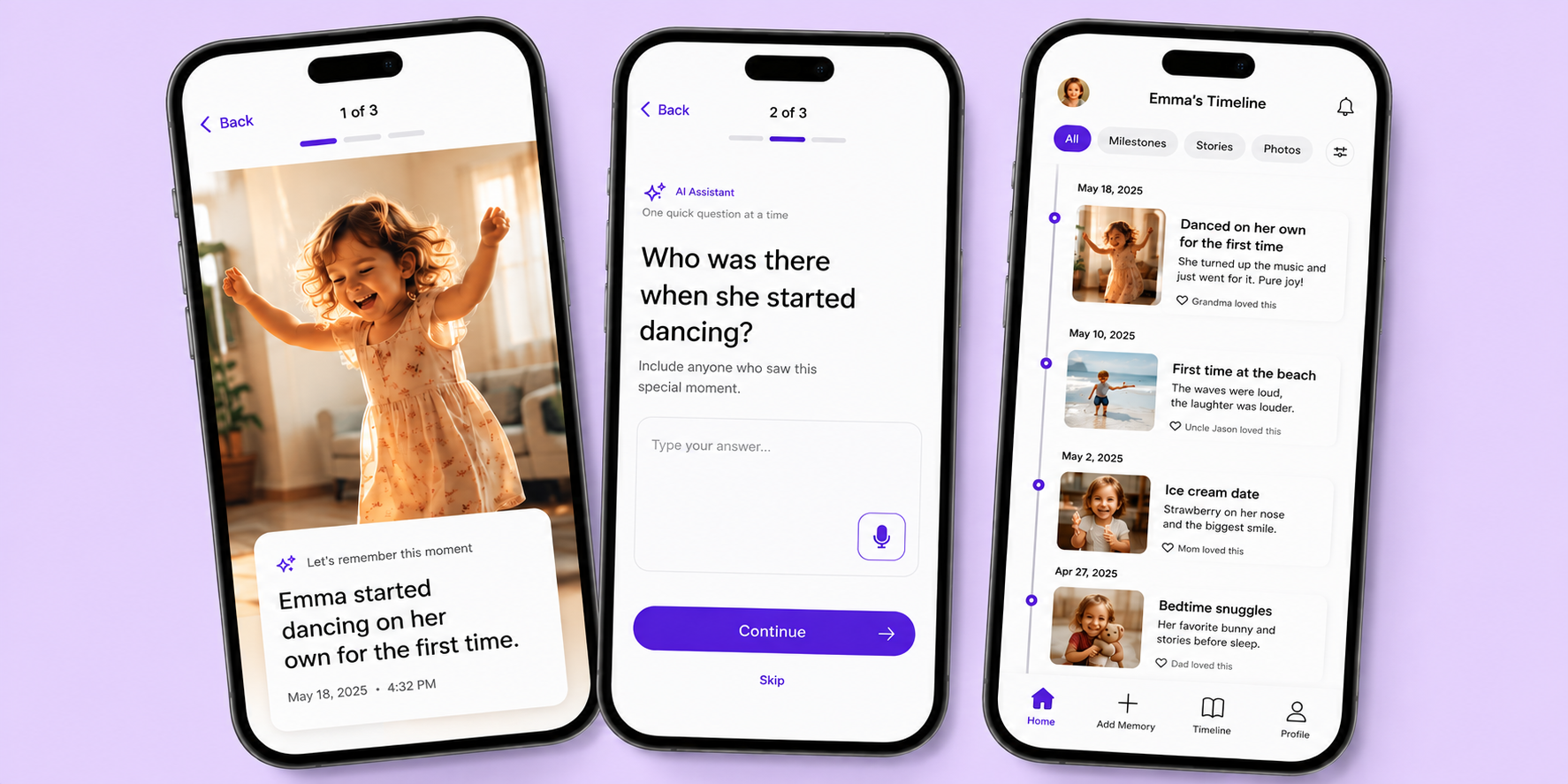
AI · Product Design · Family Memory · Prototype

EverNear — AI-Powered Family Memory App

Helping parents turn everyday moments into lasting memories through AI-assisted storytelling. An ongoing product experiment exploring how AI can help parents reconstruct, preserve, and share the moments they don't have the time or energy to document in real time.

EverNear — AI-Powered Family Memory App
Role

Product Designer & AI-Native Design Lead

Challenge

Explore whether AI can help sleep-deprived parents reconstruct, preserve, and share meaningful family memories they didn't have the time or energy to document in the moment.

Timeframe

Prototype → Preparing for user testing

Structure

Problem discovery, competitive research, affinity mapping, user journey mapping, UX/UI design, AI-assisted prototyping, prompt-driven development, iteration, and user testing.

Process highlights

How the work came together.

Research & Discovery

Competitive analysis, affinity mapping, and user journey mapping to understand the real friction before designing any interface.

Designing with AI

Using Claude Design as a design partner, adapting an existing design library, and building the prototype through prompt-driven development.

From Idea to Prototype

Moving quickly from research and synthesis to an MVP that is good enough to test the core memory-reconstruction experience.

Iteration & Testing

Preparing for user testing to learn what parents remember, how much AI should infer, and where the experience needs to improve.

The Problem

Having a baby is full of moments you want to remember forever.

But actually documenting those moments? That's a different story.

During the early months of parenthood, my partner and I were sleep deprived, overwhelmed, and constantly feeling guilty that we weren't documenting enough of our baby's development or sharing those moments with family and friends overseas.

We weren't the only ones.

When I started talking to other parents, I heard similar stories. Parents wanted to remember the little things, but often didn't have the time or energy to record them as they happened. Some couldn't even remember exactly when major milestones had occurred — when their baby first rolled over, crawled, laughed, or did something completely new.

That realization kept bothering me.

What if you didn't have to document everything in the moment to be able to remember it later?

So I started researching.

Finding the Gap

I began by looking at the existing baby and family journaling landscape.

There are plenty of apps designed to help parents record milestones, journal moments, track development, and save photos.

But I noticed a different opportunity:

What happens to all the moments that were never documented?

Instead of asking exhausted parents to become better documentarians, I wanted to explore whether technology — and particularly AI — could help reconstruct memories from the fragments parents already have.

A photo. A text message. A conversation. A vague recollection. A date on the calendar.

Could those fragments become a meaningful story?

That became the foundation for EverNear.

Research & Discovery

Before jumping into the interface, I wanted to understand the problem properly.

I conducted a competitive analysis to understand how existing products approached baby journaling, milestone tracking, and family memory keeping.

I then used FigJam to synthesize what I was learning through:

Competitive analysis

Affinity mapping

User journey mapping

Problem exploration

Early user flows

The goal wasn't just to make an attractive AI interface.

It was to understand where the real friction was and make sure the product concept was solving something people actually struggled with.

Designing with AI

Once I had a clearer direction, I started experimenting with Claude Design as part of the design process.

Rather than starting completely from scratch, I used one of Claude Design's existing design libraries as a foundation and adapted the visual direction, including the colour palette, to fit EverNear.

From there, I started building through prompts.

I fed the process with the work I'd already done — including my research, user flows, synthesized context, and design thinking — rather than treating the AI as a blank canvas.

I also used another LLM to help me formulate and refine prompts, and used Figma mid-fidelity designs to communicate interactions and layouts when words alone weren't precise enough.

This became a very different kind of design workflow:

Research → synthesize → design → prompt → build → evaluate → refine

Instead of designing everything upfront and then handing it off to development, I could move continuously between these stages.

From Idea to Prototype

The prototype is now almost ready for its first round of testing.

And that's intentional.

I'm not trying to build the perfect product before putting it in front of people.

The goal is an MVP that is good enough to test the core experience, see where the concept holds up — and where it doesn't — gather real feedback, and iterate from there.

There is still plenty I want to explore — from the quality of AI-generated memories to the interaction model, onboarding, and how much control parents want over the stories being created.

But I want those decisions to be informed by real behaviour and feedback, not assumptions.

What I've Learned So Far

AI makes building faster. It doesn't replace thinking.

One of the biggest lessons from this project has been that fast prompting is incredibly powerful — but only when it's grounded in good research and planning.

Without that foundation, it's easy to generate a lot of UI very quickly without knowing whether any of it is actually moving the product in the right direction.

The research, user flows, and synthesis helped me stay anchored to the original problem, reduce unnecessary clutter, and keep track of why I was making each decision.

It also helped prevent my conversations with AI from becoming an overwhelming stream of avoidable iterations.

Communication is part of the design process.

I've learned to use multiple forms of communication depending on what I'm trying to achieve.

Sometimes a prompt is enough.

Sometimes another LLM helps me think through how to structure the prompt.

And sometimes the clearest way to communicate what I want is simply to drop in a Figma mid-fi and say:

This. But change this. And here's why.

Being able to move between text, research, flows, and visual references has become an important part of my AI-native workflow.

Don't confuse polish with progress.

Claude is incredibly capable of producing polished interfaces very quickly.

Which makes it surprisingly easy to spend too much time perfecting the UI before you've proven that the underlying experience works.

I'm deliberately resisting that.

The goal right now is an MVP that is good enough to test.

Learn.

Iterate.

Test again.

Then polish.

As my old boss used to say: fail fast.

What's Next

The next phase is testing.

I'll be using the prototype to understand:

Does the memory reconstruction concept actually resonate with parents?

What information do parents naturally have available to reconstruct a memory?

How much should AI infer versus ask the user?

Does the resulting story feel authentic and meaningful?

Where does the experience create friction?

What would make someone come back and use it?

From there, I'll iterate quickly based on what I learn.

Testing → insights → iteration → polish → shipping.

And I'll be documenting the process as I go.

This case study is intentionally still in progress — because the most interesting part is what happens next.

Stay tuned.

Outcome

An MVP prototype that helps parents reconstruct meaningful memories from everyday fragments — designed for testing, feedback, and rapid iteration.

Recommendations

"Amanda's unwavering work ethic was consistently impressive, meeting project deadlines with high-quality results under tight time constraints. Her collaborative mindset and expertise played a pivotal role in upskilling team members and overall proficiency."
Frank SchiraldiVP, Platform Architect at Sago